

Isotope labeling
As peptides become more and more widely and deeply used in the field of biomedicine, the demand for labeled and modified peptides is increasing, and the quality requirements are also getting higher and higher. Stable isotope labeling is a typical example. Stable isotope labeling tracing can realize the study of peptide metabolic pathways, and can track the changes in position and quantity of isotope-labeled peptides in vivo or in vitro at any time. Isotope labeling has the advantages of high sensitivity, simple positioning, and accurate quantification, making isotope modification more and more popular in the fields of medicine and biochemistry.
Stable isotope peptide classification:
- N15 labeled isotope peptides
- C13 labeled isotope peptides
- N15, C13 Double labeled isotope peptides
The difference between isotope-labeled polypeptides and ordinary peptides lies in the number of amino acids in one or several amino acids in their structure. C quilt C13 replace or N quilt N15 replace.
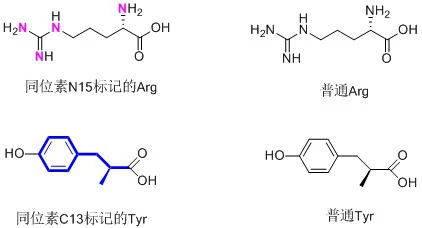
Advantages of isotope labeling:
- High sensitivity
- Simple method
- Accurate positioning and quantification
- Meet physiological conditions
Company advantages:
Use high quality N15, C13 marked Fmoc amino acids Arg, Val, Leu and other raw materials, using Fmoc Solid-phase synthesis process to synthesize stable isotope peptides. use HPLC The product was purified. The final product provides corresponding mass spectra and purity analysis. HPLC chromatogram, and COA.
Synthetic case (example):
1. IVNNDFNFNDVNFR (13C6,15N4)
2. LTVAGESFTVK (13C6,15N2)
3. Ac-[Ile(13C)]-Tyr-Gly-Glu-Phe-NH2