Shanghai Sonyt Biotechnology Co., Ltd. is one of the leading manufacturers and suppliers of peptide 12d (mastoparan-like peptide 12d) in China, also supports custom service. Welcome to wholesale bulk high quality peptide 12d (mastoparan-like peptide 12d) from our factory. Contact us for more details.
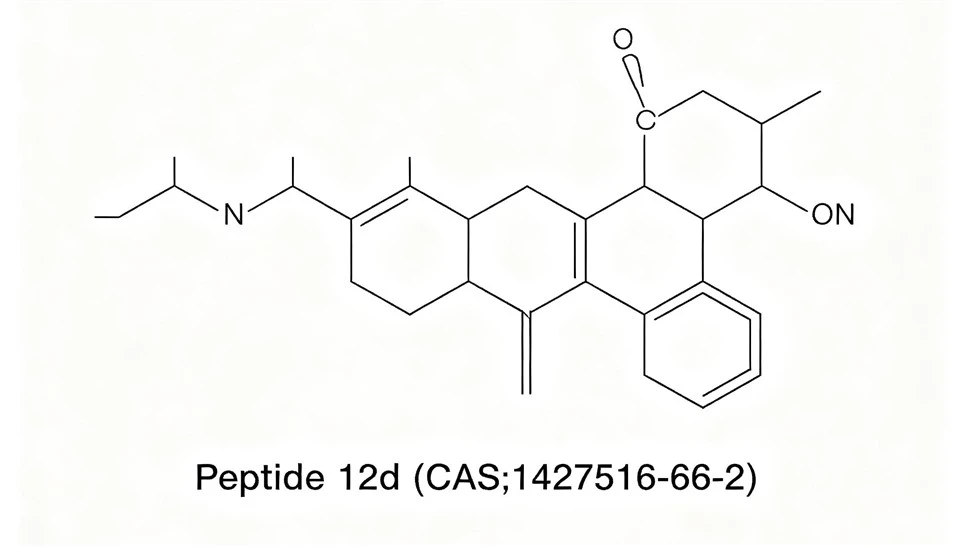
| Description | Peptide 12d (CAS: 1427516-66-2) is a 14-residue mastoparan-like peptide isolated from the venom of the giant hornet Vespa magnifica, sequence INLKAIAAMAKKLL. Molecular formula C69H128N18O16S, MW 1497.93 Da. Peptide 12d is highly homologous to Peptide 12a (INWKGIAAMAKKLL), differing by a single Leu-for-Trp substitution at position 2. Peptide 12d exerts antimicrobial effects by stimulating mast cell degranulation, with activity against Gram-negative E. coli, Gram-positive S. aureus, and the fungus C. albicans. Mastoparan-like peptides are major venom allergens that adopt amphipathic alpha-helices and act through G-protein activation and membrane permeabilization. Peptide 12d is a tool for studying wasp venom innate immunity and mast cell biology. |
| Structure type | Linear 14-mer (V. magnifica venom mastoparan-like alpha-helix, contains Met) |
| Solubility | Readily soluble in water, dilute acetic acid |
| Storage | Powder -20C, dry, protected from light |
Product Basic Information Table
| Product Standard English Name | Product Abbreviation / Alias | Function Tags (comma-separated) | Core Structure | Molecular Formula | Exact Mass (Da) | Average MW (Da) | Salt Form | Length (aa) |
| Peptide 12d (Mastoparan-like peptide 12d) | Peptide 12d; Mastoparan 12d; MP-12d | Antimicrobial peptide, mast cell degranulating peptide, wasp venom, α-helical peptide, membrane-active peptide, antifungal | Linear cationic amphipathic tetradecapeptide, 14 aa; adopts α-helical conformation upon membrane interaction; 3 Lys (net charge +3) and 1 Met (Met9); rich in Ala (4) and Leu (3) with a distinct hydrophobic face; no Cys/disulfide bonds; naturally isolated from Vespa magnifica venom | C₆₉H₁₂₈N₁₈O₁₆S | 1496.95 | 1497.96 | Free peptide (commercial free-acid form; natural form may be C-terminally amidated) | 14 |
Physicochemical Solubility & Storage Parameters
| Product Code | Appearance | Long-term Storage | Short-term Storage | Solution Stability | Solid Powder Stability |
| PEP-P12D-01 | White powder | Store at -20°C, sealed, desiccated, protected from light (stable 3 years). Aliquot to avoid repeated freeze-thaw. Due to Met9 (oxidation-sensitive), recommend inert gas (Ar/N2) headspace. | 2–8°C, sealed and desiccated (~2 years); stable for shipping at ambient. Working aliquots at -20°C for up to 1 month; -80°C for up to 6 months. | Net charge +3 but relatively hydrophobic (4 Ala + 3 Leu + 2 Ile = 9/14 hydrophobic residues); moderate water solubility (~0.5–1 mg/mL). Prepare stock solutions in DMSO (5–10 mg/mL) then dilute into aqueous buffer. Contains 1 Met (Met9) prone to oxidation in solution; no Cys, Trp, or Tyr. Protect from light; prepare fresh or store working aliquots at -80°C. Avoid strong oxidizing agents. | Stable as powder for 3 years at -20°C, desiccated and protected from light; ~2 years at 4°C. Hygroscopic. Long-term storage under inert gas recommended due to Met oxidation sensitivity. |
Functional Description
| Product Code | Frontend Short Summary (for search list display) | Detailed Biological Function Description | Applicable Research Areas (comma-separated) | Targets / Pathways |
| PEP-P12D-01 | A 14-residue amphipathic mastoparan peptide from Vespa magnifica venom, with antimicrobial activity against E. coli, S. aureus, and C. albicans, plus G-protein-mediated mast cell degranulation. | Peptide 12d is a tetradecapeptide of the mast cell degranulating peptide family isolated from the venom of the Chinese giant hornet Vespa magnifica. It adopts an amphipathic α-helix in membrane environments and activates mast cell GTP-binding proteins (G proteins/Gi/Go), triggering histamine release-the basis of the inflammatory response to wasp stings. Additionally, Peptide 12d has broad-spectrum antimicrobial activity against E. coli (MIC ~3.0 µg/mL), S. aureus, and the fungus C. albicans. Its antimicrobial mechanism involves electrostatic binding to bacterial membranes followed by insertion of the hydrophobic α-helix into the lipid bilayer, causing permeabilization. This peptide is a valuable tool for studying mast cell biology, G-protein signaling, and innate immune host defense. | Antimicrobial peptide research, mast cell biology, innate immunity, wasp venom pharmacology, G-protein signaling, anti-infective drug discovery | Mast cell degranulation (GTPase/Gi/Go activation); calmodulin; bacterial membrane disruption; histamine release |
Hot Tags: peptide 12d (mastoparan-like peptide 12d), China peptide 12d (mastoparan-like peptide 12d) manufacturers, suppliers, factory, 3032621-32-9, antimicrobial peptides, CAS 188713 80 6, CAS 849352 44 9, Cilofungin, Elf18